Student LMU-CDM knoxville, Tennessee, United States
Purpose of the Study: This poster explores the advantages and disadvantages of conventional versus digitally guided implant placement techniques. Emphasis is placed on diagnostic considerations, clinical efficiency, and patient outcomes, while also highlighting the potential of digital workflows to enhance precision and predictability. Additionally, the importance of integrating these approaches into dental curricula is underscored to better prepare future practitioners.
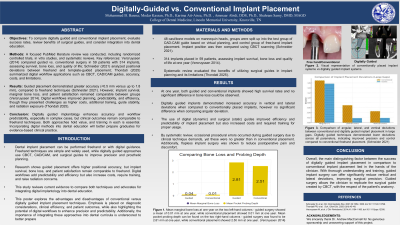
Methods: A focused literature review was conducted, incorporating randomized controlled trials, in vitro investigations, and systematic reviews (PubMed). Key references included: a randomized trial comparing guided and conventional surgery in 59 patients with 314 implants, assessing implant survival, marginal bone loss, and quality of life at one year (Vercruyssen 2014); an in vitro study evaluating positional deviations between freehand and computer-assisted template-guided placement (Schneider 2021); and a 2025 systematic review summarizing digital workflow trends, including CBCT, CAD/CAM surgical guides, accuracy, cost, and limitations (Thondati 2025).
Results: Guided implant placement demonstrated superior accuracy, with mean lateral and vertical deviations below 0.5 mm compared to deviations of up to 1.8 mm in conventional freehand placement (Schneider 2021). Despite this, clinical outcomes were similar, as both techniques yielded high implant survival at one year with no significant differences in marginal bone loss or patient satisfaction (Vercruyssen 2014). Digital workflows improved prosthetically driven planning, predictability, and efficiency, but posed challenges related to higher costs, technical training, surgical guide stability, and additional radiation exposure (Thondati 2025).
Conclusion: Digitally guided implant placement provides enhanced surgical accuracy and workflow predictability, particularly in anatomically complex cases. However, survival rates and patient-centered outcomes remain comparable to conventional freehand techniques, which continue to offer accessibility and simplicity. Mastery of both approaches is therefore essential. Incorporating digital implantology into dental education will ensure graduates are equipped to integrate evidence-based, technology-driven strategies with foundational surgical principles.
Articles: Chen CS, Hsu H, Kuo YW, Kuo HY, Wang CW. Digital workflow and guided surgery in implant therapy—literature review and practical tips to optimize precision. Clin Implant Dent Relat Res. 2025 Apr 30. doi:10.1111/cid.70038.
Hultin M, Svensson KG, Trulsson M. Clinical advantages of computer-guided implant placement: a systematic review. Clin Oral Implants Res. 2012;23(Suppl 6):124–135. doi:10.1111/j.1600-0501.2012.02545.x.
Schneider D, Sax C, Sancho-Puchades M, Hämmerle CHF, Jung RE. Accuracy of computer-assisted, template-guided implant placement compared with conventional implant placement by hand: an in vitro study. Clin Oral Implants Res. 2021;32:1052–1060. doi:10.1111/clr.13799. Thondati PR, Manandhar S, Pinnamaneni M, Kalakota S, Bhola R, Singh S. Digital implant planning and guided surgery: current trends and clinical outcomes. Sch J Dent Sci. 2025;12(4):43–48.
Vercruyssen M, van de Wiele G, Teughels W, Naert I, Jacobs R, Quirynen M. Implant- and patient-centred outcomes of guided surgery: a 1-year follow-up randomized clinical trial comparing guided surgery with conventional implant placement. J Clin Periodontol. 2014;41:1154–1160. doi:10.1111/jcpe.12305.