Implant Dentist Brighterway Dental Institute Phoenix, Arizona, United States
Purpose of the Study: Piezosurgery is often utilized for maxillary sinus lift via high-frequency ultrasonic vibrations. If the vibrations are prolonged or intense, they may affect tinnitus, a constant hearing of ringing or buzzing noises in ears1.
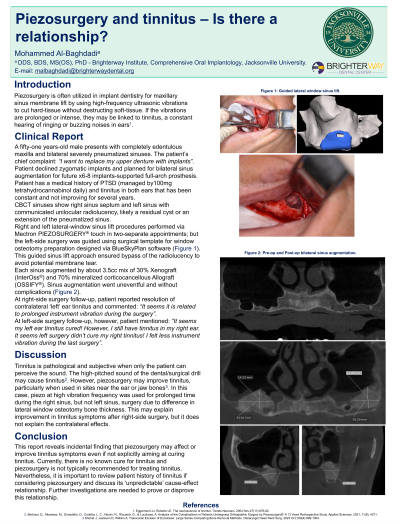
Methods: A fifty-one years-old male presents with edentulous maxilla and bilateral pneumatized sinuses. Patient planned for bilateral sinus augmentation for implants-supported full-arch prosthesis. Patient has a history of constant, not improving, tinnitus in both ears for several years. CBCT sinuses show right sinus septum and left sinus with communicated unilocular radiolucency, likely a residual cyst or sinus extension. Bilateral-window sinus lifts performed via piezosurgery in two-separate appointments, but the left-side surgery was guided to bypass radiolucency and avoid membrane tear.
Results: Procedures went uneventful and without complications. At right-side surgery follow-up, patient reported resolution of contralateral ‘left’ ear tinnitus and commented: “It seems it is related to instrument vibration during the surgery”. At left-side surgery follow-up, however, patient mentioned: “It seems my left ear tinnitus cured, but I still have tinnitus in my right ear. It seems left surgery didn’t cure my right tinnitus! I felt less instrument vibration during the last surgery”.
Conclusion: High-pitched sound of dental/surgical drill and high-frequency vibrations of piezosurgery, particularly when used in ear or jaw-bones, may cause or resolve tinnitus2,3. In this case, piezo at high vibration frequency was used far more during the right, not left, sinus surgery due to difference in window osteotomy bone thickness. This may explain improvement in tinnitus symptoms after right-side surgery; it does not, however, explain the contralateral effects. Even if not aiming at curing tinnitus, this incidental finding reveals the importance to review patient history of tinnitus if considering piezosurgery and discuss its ‘unpredictable’ cause-effect relationship. Further investigations are needed to prove or disprove this relationship.
Articles: 1. Eggermont JJ, Roberts LE. The neuroscience of tinnitus. Trends Neurosci. 2004 Nov;27(11):676-82. 2. Bertossi, D., Albanese, M., Donadello, D., Carletta, L. C., Nocini, R., Ricciardi, G., & Lucchese, A. Analysis of the Complications in Patients Undergoing Orthognathic Surgery by Piezosurgery®: A 13 Years Retrospective Study. Applied Sciences. 2021; 11(9), 4271. 3. Shohet J, Justeson D, Wilkins A. Transcanal Excision of Exostoses: Large Series Comparing Bone Removal Methods. Otolaryngol Head Neck Surg. 2023 Oct;169(4):999-1004.