Dental Student Lincoln Memorial University - College of Dental Medicine Knoxville, Tennessee, United States
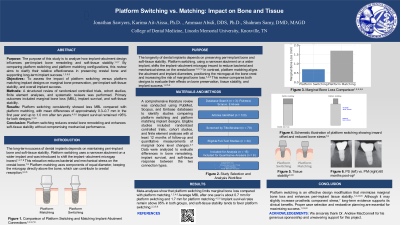
Purpose of the Study: Preservation of peri-implant crestal bone is essential for implant longevity, soft-tissue stability, and esthetic success. Even minor bone loss can compromise biologic width and papillary fill, particularly in the esthetic zone. Platform switching (PS), which uses a narrower abutment on a wider implant platform, was introduced to reduce crestal remodeling by shifting the implant–abutment microgap inward and redistributing stress. Platform matching (PM), the traditional approach, maintains equal abutment–implant diameters. Determining the relative advantages of PS versus PM remains clinically important for optimizing implant outcomes.
Methods: A structured review of the literature was conducted, including randomized controlled trials, cohort studies, finite element analyses, and systematic reviews directly comparing PS and PM. Primary outcomes assessed were marginal bone loss (MBL), implant survival, peri-implant soft-tissue response, and biomechanical performance.
Results: PS consistently reduced MBL compared with PM, with differences of 0.3–0.7 mm in the first year and approximately 1.0 mm versus 1.7 mm at 10 years (Aslam & Ahmed, 2016; Atieh et al., 2010; Raco et al., 2023). Both PS and PM achieved high survival rates (>95%) (Atieh et al., 2010; Souza et al., 2019). Biomechanical studies show that PS redistributes stress away from crestal bone but increases prosthetic component stress, though clinical complication rates remain low (Hsu et al., 2013; Souza et al., 2019). Biologically, PS supports soft-tissue preservation, re-establishment of biologic width, and reduced crestal remodeling (Vela-Nahón et al., 2018; Berglundh et al., 2012; Tellechea et al., 2016).
Conclusion: Platform switching provides a consistent benefit in limiting crestal bone loss and supporting peri-implant soft-tissue stability, without compromising survival. Clinical use should be guided by prosthetic design, tissue phenotype, implant depth, and loading conditions.
Articles: 1. Aslam M, Ahmed HM. Platform-switching to preserve peri-implant bone: A meta-analysis. J Clin Diagn Res. 2016;10(4):ZE01-ZE04. doi:10.7860/JCDR/2016/17482.7699 2. Atieh MA, Ibrahim HM, Atieh AH. Platform-switching for marginal bone preservation around dental implants: A systematic review and meta-analysis. J Periodontol. 2010;81(10):1350-1366. doi:10.1902/jop.2010.100232 3. Berglundh T, Abrahamsson I, Lindhe J. The mucosal attachment at implants and teeth: A 5-year prospective study. Clin Oral Implants Res. 2012;23(6):681-687. doi:10.1111/j.1600-0501.2011.02256.x 4. Hsu YT, Lin CL, Chang JZ. Biomechanical effects of platform switching in two different implant systems: A 3D finite element analysis. J Dent Sci. 2013;8(4):295-303. doi:10.1016/j.jdsci.2013.01.002 5. Raco M, Sanz M, Sanz-Sánchez I. Long-term clinical and radiographic analysis of platform matching and platform switching implants in the esthetic zone: A retrospective cohort study. Appl Sci. 2023;13(1):661. doi:10.3390/app13010661 6. Souza RM, Lima JH, Souza JC. Evaluation of the differences in the stability of alveolar bone around dental implants: A systematic review and meta-analysis. Appl Sci. 2019;9(12):4975. doi:10.3390/app9124975 7. Tellechea A, Lemos CA, Oliveira R. Platform switching for marginal bone preservation around dental implants: A systematic review and meta-analysis. J Periodontol. 2016;87(6):621-633. doi:10.1902/jop.2016.150643 8. Vela-Nahón R, García-Medina A, García-González J. Platform switching and peri-implant soft tissue response: A systematic review. J Clin Periodontol. 2018;45(9):1061-1070. doi:10.1111/jcpe.12952