Associate Professor Prosthodontics, CDER, AIIMS New Delhi Delhi, Delhi, India
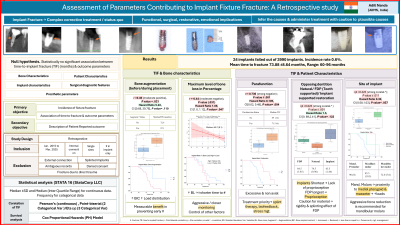
Purpose of the Study: Mandibular first molar is an important tooth site. This is the most replaced and implanted site in case of single implant rehabilitation. Loss of an implant due to fracture in this site leads to disturbance in oral homeostasis and the need for complex corrective treatments. This can demoralize the patient and frustrate the operator from dental treatment in the future. Understanding the multifactorial etiology of implant fixture fracture is crucial for prevention and improved long-term outcomes in implant dentistry. This study aims to systematically investigate the various fracture, bone, patient implant, and surgical-diagnostic characteristics, prosthetic parameters, compliance with maintenance, and patient reported outcomes that may contribute to implant fixture fracture in the mandibular first molar region through a comprehensive retrospective analysis of clinical cases.
Methods: For this retrospective study, patients reporting to a tertiary care institute from August 2023 to July 2025, and reporting with fixture fracture of titanium implants were enrolled. Exclusion criteria included implants placed in sites other than the mandibular first molar, implants that fractured due to direct trauma, external connection implants, and cases with incomplete or ambiguous records.
Results: Results. The following results were noted. Fracture Characteristics. Average year of service of implants was 8.4 years. 95% occurrence of fracture at crest module. 100% mechanical complication events were observed prior to manifestation of fracture. Most commonly observed mechanical complication before implant fixture fracture was abutment screw loosening in screw retained and screwmentable crowns, and crown decementation in cement retained crowns. Bone characteristics. None of the cases were augmented prior to implant placement, and 20 % of cases were grafted simultaneous to implant placement by using particulate graft. Radiographic bone loss was observed in 100 % of cases. Maximum vertical bone loss in relation to length of implant was 35 %. Patient characteristics. There was statistically no significant difference in occurrence of fracture between males and females (P>.05). Higher event of fracture was observed in bruxers when compared to non bruxers which was statistically significant (P < .05). Implant characteristics. Occurrence of fracture was higher in narrow diameter ( < 4 mm) (100%), commercially pure titanium material of implants (92%), conical connection (86%). Surgical diagnostic features. Higher fracture incidence was observed in cases where insertion torque was beyond 50 N-cm (96%), in cases where the placement was off from upper palatal cusp by 20degree in buccolingual span. Prosthetic parameters. Higher fractures were observed in cases rehabilitated with cast restorations, in screw retained restorations, in restorations with distal cantilever of more than 2 mm, and in cases with crown:implant ratio of more than 2:1. Compliance with maintenance. Higher fractures were reported in cases showing poor compliance to follow ups. Patient reported outcome. The most common complaint at the time of incidence report was loosening of crown (66%) followed by complete loss of crown (23%). The most common corrective treatment was a fixed dental bridge (70%) followed by explanation and replantation with or without augmentation (15%). Least preferred corrective treatment was removable partial denture (3%).
Conclusion: By identifying key contributing factors, this study seeks to provide valuable insights for optimized clinical practice, improved implant design, and advancements in material science.
Articles: 1. Manfredini M, Poli PP, Giboli L, Beretta M, Maiorana C, Pellegrini M. Clinical Factors on Dental Implant Fractures: A Systematic Review. Dent J (Basel). 2024 Jun 28;12(7):200. 2. Gealh WC, Mazzo V, Barbi F, Camarini ET. Osseointegrated implant fracture: causes and treatment. J Oral Implantol. 2011 Aug;37(4):499-503.