Student Lincoln Memorial University Alexandria, Virginia, United States
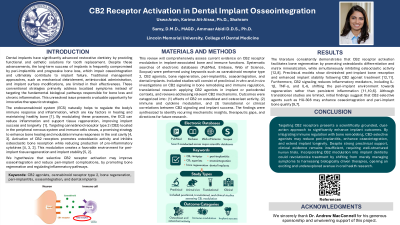
Purpose of the Study: Dental implants have significantly advanced restorative dentistry by providing functional and esthetic solutions for tooth replacement. Despite these advancements, the long-term success of implants is frequently compromised by peri-implantitis and progressive bone loss, which impair osseointegration and ultimately contribute to implant failure. Traditional management approaches, such as mechanical debridement, antimicrobial administration, and implant surface modifications, are limited in their effectiveness. These conventional strategies primarily address localized symptoms instead of targeting the fundamental biological pathways responsible for bone loss and chronic inflammation. This unresolved issue presents a valuable opportunity for innovative therapeutic strategies.
The endocannabinoid system (ECS) naturally helps to regulate the body's immune response and inflammation, which are key factors in healing and maintaining healthy bone (12). By modulating these processes, the ECS can reduce inflammation and support tissue regeneration, improving implant success and longevity (12). Targeting cannabinoid receptor type 2 (CB2) located in the peripheral nervous system and immune cells, shows a promising strategy to enhance bone healing and modulate immune responses in the oral cavity (9, 10). Activation of CB2 receptors promotes osteoblastic activity and inhibits osteoclastic bone resorption while reducing production of pro-inflammatory cytokines (9, 10, 11). This modulation creates a favorable environment for peri-implant tissue regeneration and implant stability (8, 11).
We hypothesize that selective CB2 receptor activation may improve osseointegration and reduce peri-implant complications, by promoting bone regeneration and regulating inflammatory pathways.
Methods: This review will comprehensively assess current evidence on CB2 receptor modulation in implant-associated bone and immune functions. Systematic searches of electronic databases (PubMed, Embase, Web of Science, Scopus) will be performed using keywords such as cannabinoid receptor type 2, CB2 agonists, bone regeneration, peri-implantitis, osseointegration, and dental implants. Included studies will consist of preclinical in vitro and in vivo investigations on CB2 signaling in bone remodeling and immune regulation, translational research applying CB2 agonists in implant or periodontal contexts, and reviews addressing relevant CB2 mechanisms. Outcomes will be categorized into: (1) effects of CB2 on osteoblast and osteoclast activity, (2) immune and cytokine modulation, and (3) translational or clinical correlations between CB2 signaling and implant success. The findings will be synthesized to identify recurring mechanistic insights, therapeutic gaps, and directions for future research.
Results: The literature consistently demonstrates that CB2 receptor activation facilitates bone regeneration by promoting osteoblastic differentiation and matrix mineralization, while simultaneously inhibiting osteoclastic activity (1,5). Preclinical models show diminished peri-implant bone resorption and enhanced implant stability following CB2 agonist treatment (1,2). Furthermore, CB2 signaling reduces inflammatory mediators, including IL-1β, TNF-α, and IL-6, shifting the peri-implant environment towards regeneration rather than persistent inflammation (2,3,7). Although translational studies are limited, initial findings suggest that CB2-selective agents such as HU-308 may enhance osseointegration and peri-implant bone quality (4,6).
Conclusion: Targeting CB2 receptors presents a scientifically grounded, dual-action approach to significantly enhance implant outcomes. By integrating immune regulation with bone remodeling, CB2-selective agonists may reduce peri-implantitis, enhance osseointegration, and extend implant longevity. Despite strong preclinical support, clinical evidence remains insufficient, requiring well-structured human trials. Incorporating CB2 modulation into implant dentistry could revolutionize treatment by shifting from merely managing symptoms to harnessing biologically driven therapies, opening an exciting and underexplored avenue in oral health research.
Articles: 1. Ofek O, Karsak M, Leclerc N, et al. Peripheral cannabinoid receptor CB2 regulates bone mass. Proc Natl Acad Sci U S A. 2006;103(3):696-701. doi:10.1073/pnas.0504187103.
2. Zhao Y, Zhang Y, Liu H, et al. The activation of CB2 enhances bone remodeling in periodontitis. BMC Oral Health. 2025;25(1):788. doi:10.1186/s12903-025-06101-3. PMID: 40413460; PMCID: PMC12102886.
3. Tao H, Li X, Chu M, et al. CB2 regulates oxidative stress and osteoclastogenesis through NOX1-dependent signaling pathway in titanium particle-induced osteolysis. Cell Death Discov. 2023;9:461. doi:10.1038/s41420-023-01761-y.
4. Sun H, Zhang W, Yang N, et al. Activation of cannabinoid receptor 2 alleviates glucocorticoid-induced osteonecrosis of femoral head with osteogenesis and maintenance of blood supply. Cell Death Dis. 2021;12:1035. doi:10.1038/s41419-021-04313-3.
5. Fan DY, Zhai HY, Zhao Y, et al. The role of cannabinoid receptor 2 in bone remodeling during orthodontic tooth movement. BMC Oral Health. 2024;24(1):23. doi:10.1186/s12903-023-03810-5. PMID: 38178129; PMCID: PMC10768142.
6. Chen Z, Yu Y, Lu Z, Wang R, Guo J, Wang X. A novel CB2 agonist peptide with bone-promoting activity. Bioorg Chem. 2025;163:108770. doi:10.1016/j.bioorg.2025.108770.
7. Urreola G, Le M, Harris A, Castillo JA Jr, Saiz AM, Shahzad H, Martin AR, Kim KD, Khan S, Price R. The cannabinoid pharmacology of bone healing: developments in fusion medicine. Biomedicines. 2025;13(8):1891. doi:10.3390/biomedicines13081891. PMID: 40868146; PMCID: PMC12383948.
8. Qian H, Jin Z, Li S, Huo N, Han C, Sang H. Activation of CB2 cannabinoid receptors: a novel therapeutic strategy to accelerate osseointegration of dental implants. Med Hypotheses. 2009;72(3):311-313.
9. Costela-Ruiz VJ, Illescas-Montes R, Puerta-Puerta JM, Ruiz C, Melguizo-Rodríguez L. SARS-CoV-2 infection: the role of cytokines in COVID-19 disease. Cytokine Growth Factor Rev. 2019;50:123-125.
10. Schouten LR, Vanmierlo T, Levy M, de Vries HE. Neuroinflammation and blood-brain barrier disruption: the role of the endocannabinoid system. Front Neurosci. 2022;16:796393.
11. Hegde VL, Nagarkatti M, Nagarkatti PS. Cannabinoid receptor 2 agonist ameliorates clinical score and neuropathology of relapsing-remitting experimental autoimmune encephalomyelitis. J Neuroimmune Pharmacol. 2024;19(1):81-92.
12. David C, Elizalde-Hernández A, Barboza AS, Cardoso GC, Santos MBF, Moraes RR. Cannabidiol in dentistry: a scoping review. Dent J (Basel). 2022;10(10):193. doi:10.3390/dj10100193. PMID: 36286003; PMCID: PMC9601225.