Resident LSU Health Shreveport Shreveport, Louisiana, United States
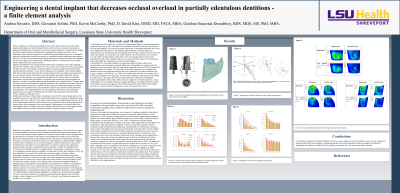
Purpose of the Study: Implants are widely used in dental practice for the replacement of lost teeth. Unlike natural teeth, implants are directly bonded to bone and do not have an inherent mechanism to buffer and redistribute the occlusal forces. Bone loss around implants is a frequent clinical finding that affects implant stability, and altered bone loading further promotes bone loss. Due to differences in the mechanical properties of solid titanium dental implants and bone, an unsuitable pattern of load bearing at crestal bone interface is a significant factor contributing to peri-implant bone loss. To achieve physiological bone loading and long-term biological fixation of the implant, the aim of the study was to evaluate the biomechanical behavior of an innovative truss implant using 3-dimensional finite element models.
Methods: The external geometric dimensions of implants in the study simulated a tapered-screw-implant, with a diameter of 5.5 mm, a taper of 4o, a length of 9.5 mm, and an apical tip radius of 4 mm. The implant was characterized by a machined gingival collar followed by microthreads that extended to 2 mm. The microthreads were contiguous with a thread of higher pitch that extended to the apical end. The internal features of the truss implant were characterized by a truss framework that connected the outer shell and the suspended central shaft. Various iterations of truss implants were constructed with different truss widths, and the solid model represented a conventional rigid implant. All implants were assigned the Young’s modulus for titanium. A model of a partially edentulous adult mandible was constructed from CT images using InVesalius software and smoothed in Autodesk Meshmixer. The mandible in correlation with the embedded implants and teeth was meshed with four-node linear tetrahedral elements in Abaqus. The implant was meshed with the same tetrahedron elements and considered bonded with bone. Bone properties were assigned based on CT scan using Bonemat software. The periodontal ligament space was created as offsetting the root surface and assigned previously described Young’s modulus and Poisson’s ratio.
Results: Placed under a compressive load of 220 N, inward displacement of the mandibular molar was twice that of the rigid implant placed in the contralateral edentulous region. Implants with a truss width of 0.4 mm showed similar intrusive and displacement behaviors as the molar. Rigid implant simulations showed high stresses in interface bone at the first thread and the crestal surface when compressive forces were applied. Displacement of the central shaft of the truss implant reduced von Mises stress at the interface and crestal bone. Our data suggest that the truss implants placed in partially edentulous dentitions could limit implant overload.
Conclusion: Placed under a compressive load of 220 N, inward displacement of the mandibular molar was twice that of the rigid implant placed in the contralateral edentulous region. Implants with a truss width of 0.4 mm showed similar intrusive and displacement behaviors as the molar. Rigid implant simulations showed high stresses in interface bone at the first thread and the crestal surface when compressive forces were applied. Displacement of the central shaft of the truss implant reduced von Mises stress at the interface and crestal bone. Our data suggest that the truss implants placed in partially edentulous dentitions could limit implant overload.
Articles: 1. Wang CY, Su MZ, Chang HH, Chiang YC, Tao SH, Cheng JH, Fuh LJ, Lin CP. Tension-compression viscoelastic behaviors of the periodontal ligament. J Formos Med Assoc. 2012;111(8):471-481.
2. Naert I, Duyck J, Vandamme K. Occlusal overload and bone/implant loss. Clin Oral Implants Res. 2012;23(suppl 6):95-107.
3. Nagasawa M, Takano R, Maeda T, Uoshima K. Observation of the bone surrounding an overloaded implant in a novel rat model. Int J Oral Maxillofac Implants. 2013;28(1):109-116.
4. Michalakis KX, Calvani P, Hirayama H. Biomechanical considerations on tooth-implant supported fixed partial dentures. J Dent Biomech. 2012;3:1758736012462025.
5. Akbas O, Greuling A, Stiesch M. The effects of different grading approaches in additively manufactured dental implants on peri-implant bone stress: a finite element analysis. J Mech Behav Biomed Mater. 2024;154:106530.
6. Zhang C, Zeng C, Wang Z, Zeng T, Wang Y. Optimization of stress distribution of bone-implant interface. Biomater Adv. 2023;147:213342.
7. Kok HI, Kick M, Akbas O, et al. Reduction of stress-shielding and fatigue-resistant dental implant design through topology optimization and TPMS lattices. J Mech Behav Biomed Mater. 2025;165:106923.
Books: 1. Resnik RR. Misch’s Contemporary Implant Dentistry. 4th ed. St. Louis, MO: Elsevier; 2020. 2. Misch CE. Dental Implant Prosthetics. 2nd ed. St. Louis, MO: Mosby/Elsevier; 2015. 3. Berglundh T, Giannobile WV, Lang NP, Sanz M, eds. Lindhe’s Clinical Periodontology and Implant Dentistry. 7th ed. Hoboken, NJ: Wiley-Blackwell; 2021.